

Port Infrastructure Market to Grow to USD 371.5 Billion by 2035 as Automation & Sustainable Trade Infrastructure Expand
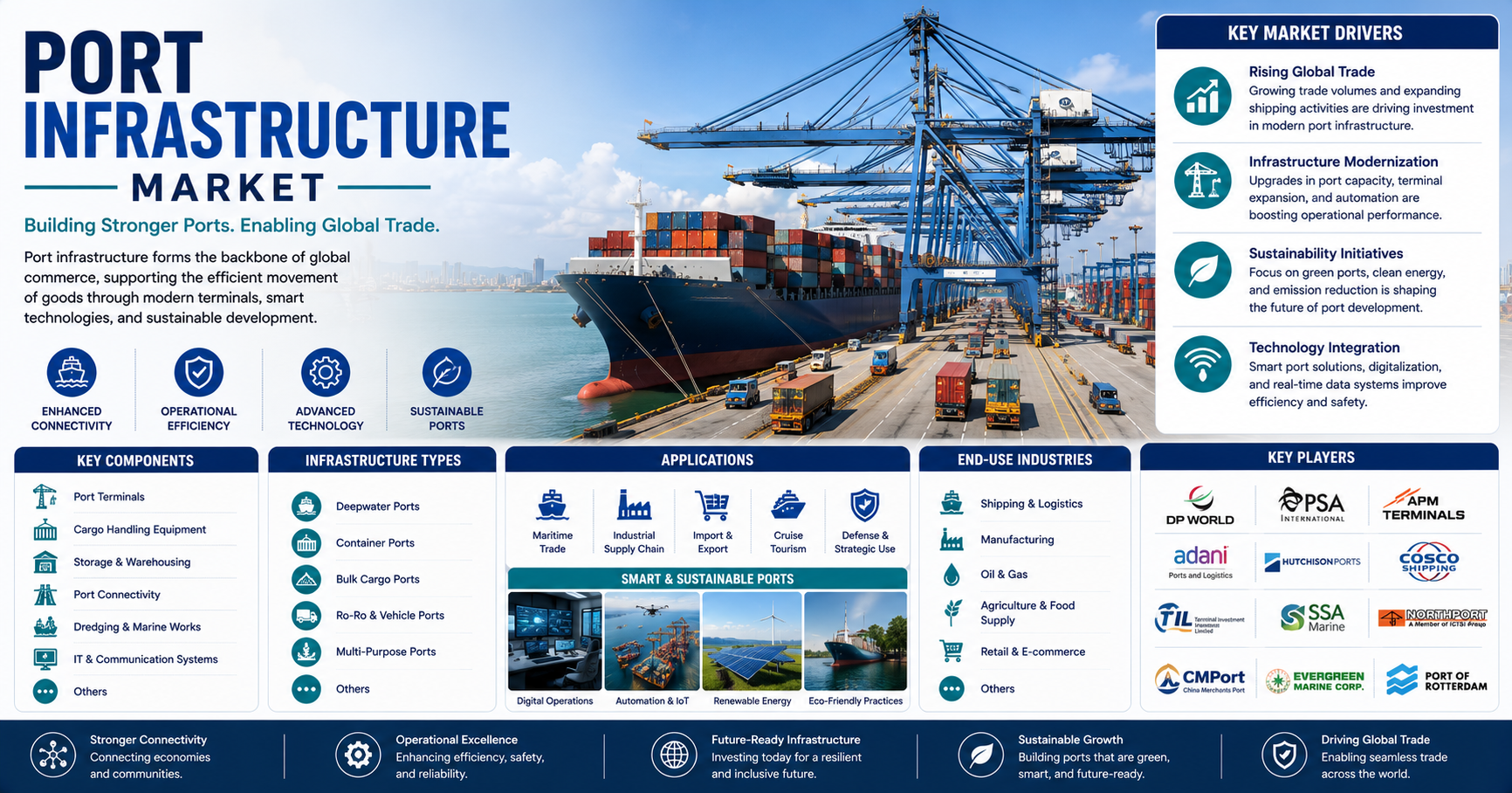
Port Infrastructure Market (2026 - 2035)
North America is expanding its port modernization pipeline through the IIJA's port-specific allocations.
OR, UNITED STATES, July 23, 2026 /EINPresswire.com/ -- Every container that crosses an ocean eventually has to pass through a strip of concrete and steel a few kilometers wide—a berth, a crane, a yard. That narrow chokepoint is where global trade actually gets built, and right now it's being rebuilt at scale. According to a report by Market Research Future (MRFR), the global port infrastructure market reached USD 225.90 billion in 2025 and is projected to climb from USD 237.42 billion in 2026 to USD 371.50 billion by 2035, registering a compound annual growth rate of 5.10%. The expansion is being driven less by a single mega-trend than by three forces converging at once: governments pouring capital into modernization, trade routes physically relocating away from single-hub dependency, and an accelerating shift toward automated, electrified terminal operations.Public Capital and Rerouted Trade Are Doing the Heavy Lifting
Government spending remains the single largest accelerant in the port infrastructure market. The U.S. Infrastructure Investment and Jobs Act allocated USD 17 billion for port and waterway improvements through 2026, while India's Sagarmala initiative has mobilized more than USD 12 billion in port-linked projects since 2015, with its next phase targeting 35 new berths by 2030. The World Bank alone committed over USD 14 billion in maritime logistics lending between 2022 and 2025—capital that shortens procurement timelines and de-risks private co-investment across the value chain.
Layered on top is trade-route realignment. Geopolitical fragmentation is pulling container volumes away from single-hub dependency: Mexico's Pacific coast ports saw a 22% throughput surge between 2022 and 2024 as U.S. importers diversified sourcing away from China, and similar dynamics are playing out in Vietnam and Morocco, where authorities are fast-tracking deep-water berth approvals to capture the re-routed demand. Each of these secondary nodes needs an entirely new landside logistics stack, which is precisely where much of the market's incremental growth is landing.
Automation is the third leg. Terminal operators are deploying automated stacking cranes, optical-character-recognition gate systems, and digital-twin simulation platforms that lift throughput per hectare by 25–40%. Rotterdam's Maasvlakte II and Shanghai's Yangshan Phase IV have already shown that fully automated yards cut labor costs by roughly 30% while raising berth productivity—proof points now catalyzing capex commitments across mid-tier ports in Southeast Asia and the Arabian Gulf.
Get Report Sample Copy with TOC: https://www.marketresearchfuture.com/sample_request/28403
Seaports Still Dominate, but Inland and Automated Terminals Are the Growth Edge
By port type, seaports account for roughly 80.6% share, reflecting the sheer scale of deep-water coastal terminals in global trade—and deep-water berth construction for Ultra-Large Container Vessels exceeding 24,000 TEU is concentrating capital among top-tier coastal hubs. Inland ports, though, are the fastest-growing segment at a projected 5.20% CAGR, as India, Brazil, and Central Europe prioritize river and rail connectivity to decongest coastal gateways and cut last-mile trucking costs by 15–25%.
By application, cargo operations represent about 83.9% of the market, while the smaller passenger segment is accelerating at roughly a 5.18% CAGR as cruise lines order larger vessels requiring purpose-built homeport terminals. On ownership, public entities still hold the larger share at 47.8%, but private operators are expanding faster—about 5.12% CAGR—as concession-based models gain ground in emerging economies that lack the fiscal capacity for self-funded development.
The technology dimension tells the clearest story about where the market is headed: conventional terminals still make up 60.5% of installed capacity, but any greenfield project breaking ground today overwhelmingly specifies at least semi-automation, and fully automated terminals—exemplified by Qingdao's QQCTN and Rotterdam's APMT Maasvlakte II, which deliver 30–40% higher throughput per hectare—are scaling at a 5.10% CAGR and setting the design template for the next generation of mega-terminals.
Asia-Pacific Leads, but the Fastest Growth Is on the Periphery
Asia-Pacific dominates the port infrastructure market with an estimated 41.5% share, anchored by China's mega-port expansion—seven of the world's ten busiest container ports by TEU are Chinese—and reinforced by China's roughly USD 66 billion 14th Five-Year Plan allocation for waterway and coastal upgrades. India is the region's fastest mover at an estimated 5.35% CAGR, and ASEAN nations, led by Vietnam's Lach Huyen and Indonesia's Patimban terminals, are racing to absorb manufacturing diversification away from China.
Europe holds the second-largest share at roughly 25.0%, propelled by the EU's Connecting Europe Facility, which earmarked EUR 25.8 billion for TEN-T transport corridors through 2027. Germany and the Netherlands lead automation adoption, while Mediterranean hubs in Italy and Spain are building transshipment capacity to capture Asia–Europe relay volumes.
North America is in the midst of its most significant modernization cycle in decades, funded by the IIJA's port allocations and channel-deepening projects along the Gulf and East Coasts built to accommodate Neo-Panamax vessels. But the highest-growth frontier is the Middle East & Africa region, projected at roughly a 5.25% CAGR, as Gulf states leverage sovereign wealth to build transshipment mega-hubs—Saudi Arabia's Vision 2030 logistics agenda alone targets USD 12 billion in port-related investment—while East African nations like Kenya and Tanzania develop first-generation deep-water facilities in a region that today handles less than 4% of global container throughput despite a coastline exceeding 30,000 km.
Buy Now: https://www.marketresearchfuture.com/checkout?currency=one_user-USD&report_id=28403
What's Slowing the Build-Out
The port infrastructure market's biggest constraint is sheer capital intensity. A single deep-water container berth can cost USD 500 million to USD 1.2 billion, with concession payback horizons stretching 20–30 years—a burden compounded by sovereign credit ratings and currency volatility in emerging markets that discourages greenfield bids, particularly across Sub-Saharan Africa and South Asia.
Regulatory and environmental permitting adds years to project timelines: EU coastal-construction environmental impact assessments typically take 3–5 years, and U.S. Army Corps of Engineers navigation-channel deepening permits can stretch to 7 years, creating a persistent lag between investment intent and actual construction. Meanwhile, geopolitical disruption—2024's Red Sea shipping diversions and ongoing Taiwan Strait tensions among them—introduces route volatility that complicates long-range capacity planning, raising the risk that operators build for demand corridors that shift before a project even reaches operational status.
Where the Opportunity Is Building
The clearest near-term opportunity is alternative-fuel bunkering infrastructure. As IMO carbon-intensity regulations tighten toward the target of a 40% cut versus 2008 levels by 2030, ports that install methanol, ammonia, and LNG bunkering facilities first stand to capture fuel-supply revenue estimated at USD 18 billion annually by 2032—early movers in Singapore and Antwerp-Bruges are already winning preferential route allocations from liner alliances.
Digital port-community platforms are a second major lever: integrating customs, terminal operations, and inland logistics onto a single data layer can cut cargo dwell time by 20–30%, and Singapore's MPA and Rotterdam's Portbase have shown that shared data ecosystems can cut document-processing time by up to half—turning what used to be a cost-center IT project into a genuine transaction-fee revenue model.
Longer term, climate-resilient retrofits represent a large, incremental capital pool: the OECD expects cumulative climate-adaptation spending at coastal ports to exceed USD 50 billion by 2035 as authorities reinforce breakwaters and raise quay elevations against rising seas. And emerging-market greenfield development—new-build projects like Lamu Port in Kenya and Bagamoyo in Tanzania—offers the market genuine geographic expansion rather than incremental upgrades to already-mature hubs.
Report Summary: https://www.marketresearchfuture.com/reports/port-infrastructure-market-28403
Competitive Landscape
The port infrastructure market shows moderate concentration, with the top five players holding an estimated 22–28% combined revenue share—a mix of state-backed construction conglomerates, global terminal operators, and EPC contractors. China Communications Construction Co. (CCCC) leads through dredging, quay construction, and terminal design-build work concentrated in Asia-Pacific and Belt & Road-linked projects. DP World operates the largest global concession portfolio, spanning more than 40 countries, and was awarded a 30-year, USD 1.5 billion concession for Jeddah's new Red Sea Gateway Terminal in late 2023; it also announced a USD 1.2 billion expansion of Jebel Ali Terminal 4 in October 2024, adding 3.1 million TEU of capacity along with shore-power connectivity for all new berths.
APM Terminals leverages vertical integration with parent liner operator Maersk, while Hutchison Port Holdings and PSA International maintain deep pan-Asian, European, and Singapore-hub positions respectively. Bechtel Corporation and China Harbour Engineering Co. anchor large-scale greenfield marine civil works in emerging markets, and advisory-and-design specialists AECOM, Fluor Corporation, and Royal HaskoningDHV round out a field where design expertise and financing structuring matter as much as construction scale.
Related Report
Infrastructure Construction Market https://www.marketresearchfuture.com/reports/infrastructure-construction-market-16136
transportation infrastructure market https://www.marketresearchfuture.com/reports/transportation-infrastructure-market-28550
transportation infrastructure construction market https://www.marketresearchfuture.com/reports/transportation-infrastructure-construction-market-28464
cloud infrastructure in chemical market https://www.marketresearchfuture.com/reports/cloud-infrastructure-in-chemical-market-36160
Market Research Future
Market Research Future
+1 855-661-4441
email us here
Legal Disclaimer:
EIN Presswire provides this news content "as is" without warranty of any kind. We do not accept any responsibility or liability for the accuracy, content, images, videos, licenses, completeness, legality, or reliability of the information contained in this article. If you have any complaints or copyright issues related to this article, kindly contact the author above.
